UV printable materials / BUYER GUIDE
What Materials Can UV Printers Print On? A Buyer鈥檚 Guide to Plastic, Metal, Glass, Wood, and More
Learn which plastics, metals, glass, wood, ceramics, and coated products can suit UV printing鈥攁nd how to validate adhesion, appearance, and handling before production.
Introduction
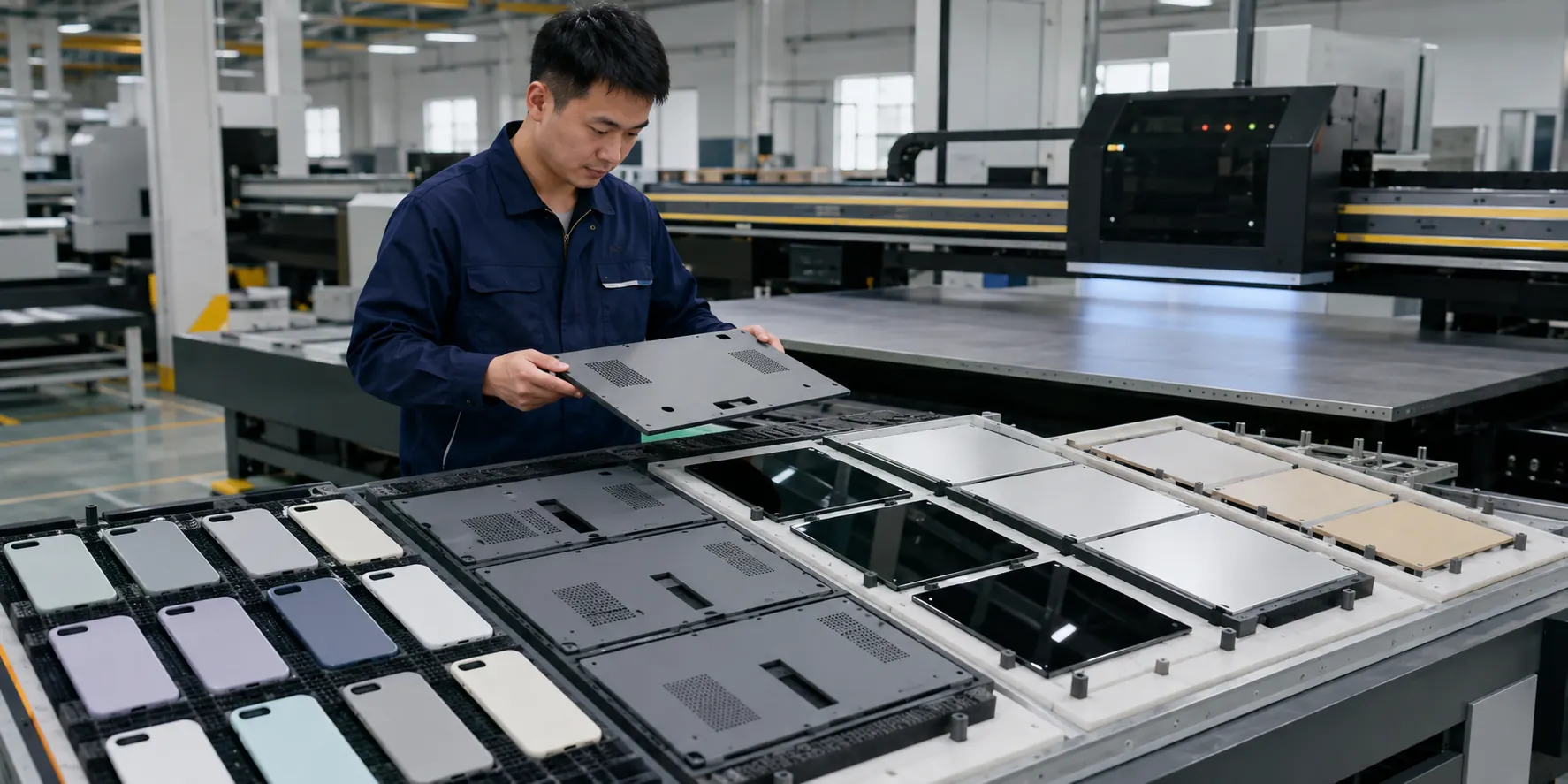
When buyers ask, “What materials can UV printers print on?”, the useful answer is not simply “almost anything.” UV direct-to-object printing can decorate a wide range of rigid products, including many plastics, coated metals, glass, acrylic, wood, ceramics, and selected leather or composite goods. But material category alone does not establish production suitability. Surface energy, coatings, texture, curvature, heat sensitivity, part geometry, and the intended use environment all affect adhesion, appearance, and repeatability.
For a sourcing team, the better question is: Can this exact product be printed consistently, inspected objectively, and shipped without the decoration failing in its real use? That is the question a sample stage should answer.
This guide explains how to assess common UV-printable materials, what to request during factory testing, and how to turn a promising sample into a lower-risk production specification. It is written for brands, distributors, promotional-product buyers, packaging teams, and OEM purchasers evaluating custom product decoration.
The Short Answer: Which Materials Work with UV Direct-to-Object Printing?
UV printers are commonly used on rigid substrates such as acrylic, many plastics, metal, glass, wood, ceramics, and coated board. Some flexible, coated, or leather-like products can also be decorated, but they require application-specific testing. A material is suitable only after the supplier confirms flatness or fixture strategy, ink adhesion, cure performance, color appearance, and handling resistance on the finished item.
The distinction matters because two products described as “aluminum,” “glass,” or “plastic” may behave very differently. An anodized aluminum bottle, a powder-coated tin, and a bare metal panel do not present the same surface. A glossy retail carton with aqueous coating does not behave like uncoated paperboard. A phone case may be ABS, polycarbonate, TPU, recycled blend, or a multi-layer construction. Procurement specifications should name the actual substrate and finish whenever possible.
How UV Direct-to-Object Printing Works
UV direct-to-object printing deposits inkjet ink directly onto a product surface. UV light then cures the ink rapidly, allowing the next operation to proceed without waiting for traditional solvent evaporation. A flatbed or object-printing system holds the part in a defined position while the print head applies CMYK and, depending on the configuration, white, clear, primer, or varnish layers.
For buyers, this workflow has several practical implications:
- Variable data and short runs are feasible. Designs, names, artwork versions, and languages can change without making a new screen for every revision.
- Opaque white can support colored or dark products. It is often used as an underbase, though opacity, registration, and edge quality must be sampled.
- Texture and gloss can be engineered. Clear or varnish layers may create tactile or selective-gloss effects. They should be treated as a separate quality requirement, not assumed to be durable on every surface.
- Fixtures control consistency. A well-designed jig is often as important as the printer. It defines placement, repeatability, and clearance on irregular objects.
UV printing is not a universal replacement for every decoration process. The production decision still depends on shape, volume, required durability, brand colors, finish expectations, and total landed cost.
Material-by-Material Assessment
Plastics: broad opportunity, but identify the resin
Rigid plastics are among the most common UV-printing applications. Acrylic, polycarbonate, ABS, PVC, and some coated or engineered plastics can be viable. Yet “plastic” is too broad for a procurement specification. Low-surface-energy materials, mold-release residue, soft-touch coatings, and recycled-content variation can reduce adhesion or change surface appearance.
Ask for the resin and finish where possible. Then request a test on production-equivalent parts rather than a generic plaque. The supplier should record whether cleaning, corona/flame treatment, or primer is used. This is not administrative detail: a primer can make the difference between a good-looking first sample and a decoration that survives handling.
Pay particular attention to flexible products. A printed rigid panel may perform well while a flexible case, squeeze component, or soft-touch shell cracks under repeated bending. If the product will flex, define a bend or handling test that reflects the actual use case before release.
Metal: finish and reflectivity drive the sample plan
Aluminum, stainless steel, coated steel, and powder-coated metal products are frequent candidates for branded printing. The visible finish matters. Smooth coated metal may accept a print differently from anodized, brushed, textured, or high-gloss metal. Highly reflective surfaces also need safe operating controls around the UV curing area; equipment manuals often flag glossy metal and glass as materials requiring particular care.
The sample should show more than central artwork. Ask to see small text, fine lines, white ink, solid color fields, and artwork near the intended print boundary. On brushed or textured finishes, inspect the result at the same viewing angle customers will use. Define whether the desired look is opaque coverage, a printed label effect, or a finish that lets the substrate character remain visible.
Glass: clean appearance requires disciplined handling
Glass can create a premium visual result, especially with white underprint or selective varnish. It also makes surface preparation and post-print handling highly visible. Fingerprints, dust, silicone contamination, and insufficient curing can undermine an otherwise attractive sample.
For glass items, approve the location and size of the printable area, including the transition around shoulder curves, seams, or handles. If the item will be washed, filled, refrigerated, or touched frequently, describe that environment early. A supplier should not imply dishwasher, food-contact, chemical, or outdoor durability unless the appropriate ink system and application-specific verification support that claim.
Wood, bamboo, and natural surfaces: expect natural variation
Wood, bamboo, cork, and other natural materials bring warmth and differentiation, but they are not uniform industrial substrates. Grain, porosity, moisture, stain, oil, coating, and color vary from piece to piece. That variation can shift apparent color and edge sharpness.
The right approval unit is usually a representative range, not a single perfect piece. Include light and dark pieces, grain variation, joints, corners, and any coated zones in the sample set. If color consistency is critical, discuss whether a white barrier layer, seal coat, or alternate decoration method is appropriate. When a brand wants the material character to remain visible, approve that visual variability explicitly rather than calling it a defect later.
Ceramics, coated products, and composites: judge the finished surface
Ceramic mugs, tiles, coated giftware, and composite products can be viable, but the printed surface is the finish presented to the ink, not merely the base material. A glazed ceramic, a matte-coated ceramic, and a silicone-coated product are separate applications. The same applies to laminated board, painted objects, and multi-material assemblies.
Request a finished-product sample and define the test area. If the item has a seam, raised rim, handle, or recess, specify whether the decoration must cross it. A flat test swatch cannot validate a complex three-dimensional object.
Leather and leather-like materials: distinguish appearance from flex durability
Leather, PU, and coated textile-like surfaces are often used for premium accessories. Their suitability depends on coating chemistry, plasticizer migration, texture, and flexing. A flat logo may look excellent after cure and still fail after a period of bending or rubbing.
For these products, build the sample around real handling: open and close a cover, bend the strap zone, stack products in packaging, and inspect contact points. If a logo sits where a hand repeatedly touches it, that should be part of the approval test rather than a post-shipment surprise.
The Factory Test Plan Buyers Should Request
A credible factory test is a documented comparison, not a single photograph taken just after printing. The exact test method should be agreed by the buyer and supplier, because the appropriate standard depends on substrate, coating, market, and end use. Adhesion checks such as tape-test methods are commonly used for coatings; ASTM D3359 is one recognized reference for measuring adhesion by tape test, but it is not a substitute for a complete product-specific qualification plan.
Use this practical sequence during sample approval:
- Confirm the production-equivalent part. Record supplier, item revision, material, color, surface finish, and date.
- Document preparation. Note cleaning, pre-treatment, primer, fixture, print profile, and cure approach. Do not require disclosure of proprietary formulas; require traceability of the process used for the approved sample.
- Print an artwork test panel on the actual item. Include brand colors, small text, fine lines, white, gradients, and any glossy or raised effect.
- Inspect after cure and after handling. Compare alignment, color, banding, pinholes, edge definition, and surface defects under agreed lighting.
- Run agreed functional checks. Examples may include rub, tape adhesion, bend, packing/stacking, or application-specific exposure. State the method, number of cycles or conditions, acceptance criteria, and who records the result.
- Retain an approved golden sample. Label it and use it at first-article inspection and shipment inspection.
The aim is not to create paperwork for its own sake. It is to prevent the common gap between a promising one-off sample and an unmanaged production process.
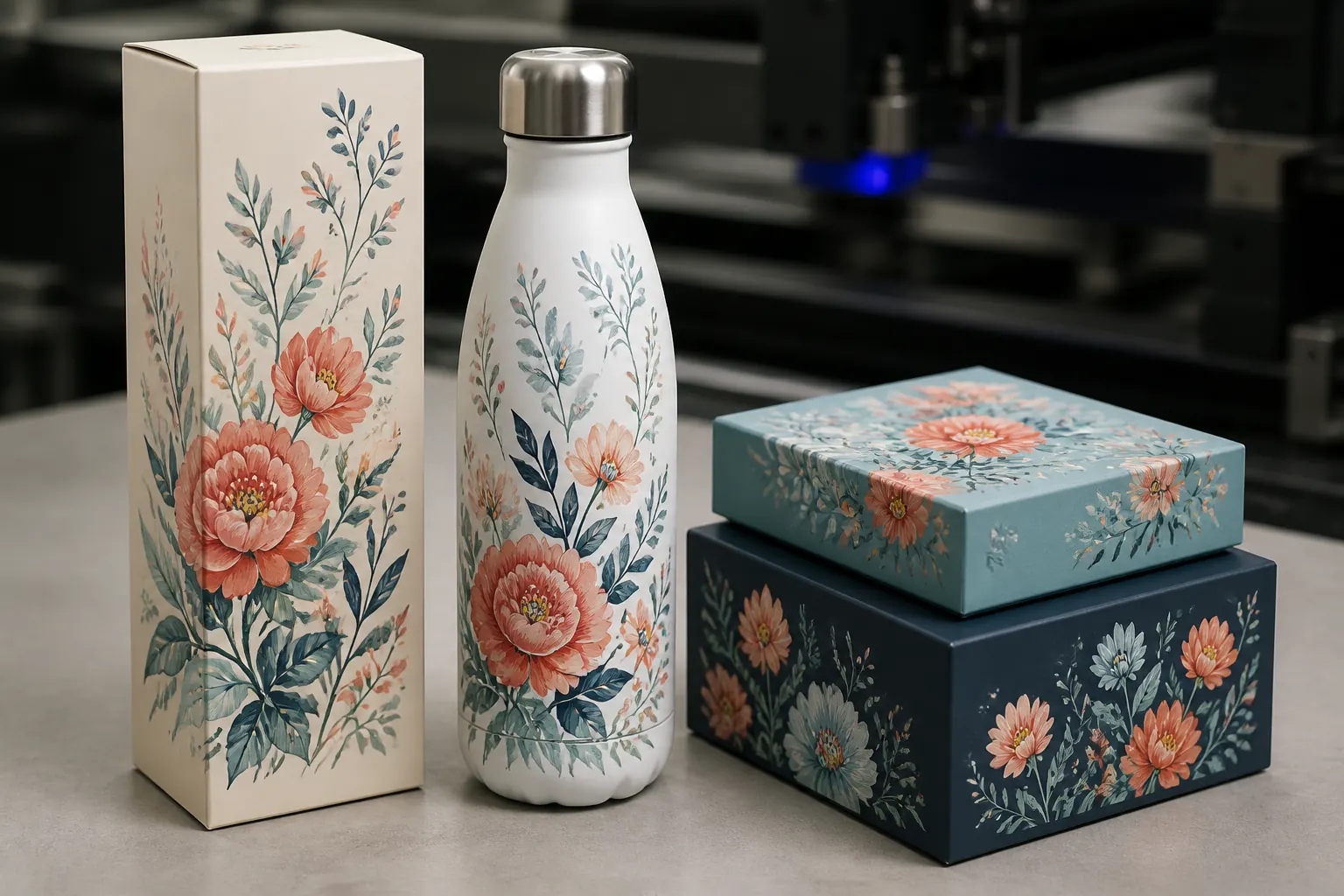
A Simple Buyer Decision Matrix
| Buyer question | What to request | Why it matters |
|---|---|---|
| Is the product truly printable? | Test on the finished, production-equivalent item | Generic plaques hide coating and geometry risks. |
| Will the artwork look right? | Actual artwork with small text, solid areas, white, and fine detail | Complex artwork exposes registration and color limitations. |
| Will it survive normal handling? | Written handling or adhesion test plan matched to use | “Durable” has no useful meaning without conditions. |
| Can repeat orders match? | Golden sample, approved artwork file, fixture reference, inspection photos | Repeatability requires a controlled reference. |
| Is the product safe to ship? | Packaging trial and shipment-inspection checkpoints | Contact, abrasion, and packing marks can occur after printing. |
Common Mistakes When Specifying UV-Printed Products
Approving only a digital rendering
A rendering cannot show the interaction between ink, finish, and geometry. It is useful for artwork approval, but not for material qualification. Always approve at least one physical sample when the decoration is business-critical.
Treating color as a screen-only decision
Color is influenced by substrate shade, white underbase, ink set, gloss, lighting, and file construction. If a brand color is important, provide the reference standard and agree how it will be judged. For demanding projects, request a signed-off drawdown or physical sample instead of relying on an RGB preview.
Leaving the print area undefined
An instruction such as “print on front” is not production-ready. Specify the printable zone, artwork position from stable physical references, maximum print dimensions, orientation, and any prohibited areas. This is especially important on bottles, cases, electronics housings, and shaped promotional products.
Using vague durability language
Avoid asking whether printing is “permanent” or “scratchproof” without an environment. Explain whether the product is an indoor giveaway, a handled consumer accessory, a display item, or an outdoor component. The right test and ink strategy follow the use condition.
FAQ
Can UV printers print on any plastic?
No. Many rigid plastics are printable, but resin type, coatings, surface energy, texture, and mold-release residue can change adhesion. Test the exact finished component and document any cleaning, treatment, or primer used.
Can UV printing be used on curved objects?
Yes, within the physical clearance and height limits of the chosen equipment and fixture. Mildly shaped objects can often be supported with a jig. Deep curves, seams, handles, and recessed areas require a feasibility test because print-head distance and registration can become limiting factors.
Does UV printing need a primer?
Sometimes. Primers or surface preparation can improve adhesion on difficult substrates, but the need and method depend on the material and ink system. Ask the supplier to state whether the approved sample used a primer and to include that step in the production control plan.
Is UV printing durable enough for retail products?
It can be appropriate for many retail products, but durability must be defined by the product’s actual handling and environment. Agree application-specific acceptance tests rather than relying on general claims.
What should I send a supplier before requesting a sample?
Send product photos or a drawing, material and finish information, printable-area dimensions, artwork, expected order volume, target market, packaging concept, and any known handling or durability requirements. These details make feasibility feedback more useful and reduce sample revisions.
Conclusion
UV direct-to-object printing opens a broad material range, but the buying decision should be based on the finished substrate and a documented sample process—not on a generic claim that a printer can print “anything.” The strongest request for quotation names the material and finish, defines the artwork and print area, states the use environment, and asks for a production-equivalent sample with agreed inspection criteria.
Technical resources and next steps
Continue with our UV printable materials guide, supplier qualification checklist, and plastic-part QC checklist.
For independent technical background, review Epson's UV flatbed overview, Roland's smartphone-case handling guidance, and Mimaki's adhesion guidance. Validate every production decision on the actual blank and approved sample.